


 Children gain so much from participation in youth sports from teamwork and great memories to the life-long healthy habit of staying active. But one of the realities of youth sports is injury. Treating youth sports injuries takes specialized knowledge. In many instances, doctors must be able to determine where a child is on his or her growth trajectory before prescribing the right course of treatment. Mary Washington Orthopedics in affiliation with FOA can provide this expertise to families throughout the Fredericksburg region, with doctors who rotate among three locations in Fredericksburg, Massaponax and North Stafford. As our December Experts, Mary Washington Orthopedics’ doctors and physical therapists share advice for parents on how to prevent and treat youth sports injuries. Stay tuned to the Fredericksburg Parent and Family Facebook page for a video with more tips later this month.
Q: At what age do youth sports injuries tend to start happening?
Kenneth J. Accousti, M.D. (Specialties: Shoulder & Elbow, Sports Medicine): It usually starts around 8 to 10 years old. The first things I tend to see are the Little League shoulder and elbow injuries. Pitchers and catchers are throwing, throwing, throwing and their bones are still developing. When they are younger than that, we may see some fractures from playground injuries, but the ligament injuries tend to start happening around 8, 9 or 10, when they start playing more organized sports.
Q: What sports are the most injury-prone?
Christopher Richards, M.D. (Specialty: Sports Medicine): Injury-rate data is important for parents to be aware of, and there is good research on this. When I did my fellowship in sports medicine at the University of Pennsylvania School of Medicine, I spent one day each week at the Children’s Hospital of Philadelphia. The sports medicine team there has put together some really helpful research and a tool that can show parents the risk of ACL tear by sport for both boys and girls. The ACL, or anterior cruciate ligament, is a key ligament that stabilizes the knee, and injuries can sideline athletes for 8-9 months. Tear rates are higher for girls than for boys. I highly recommend parents consult this data. You can find it online at bitly.com/aclstats.
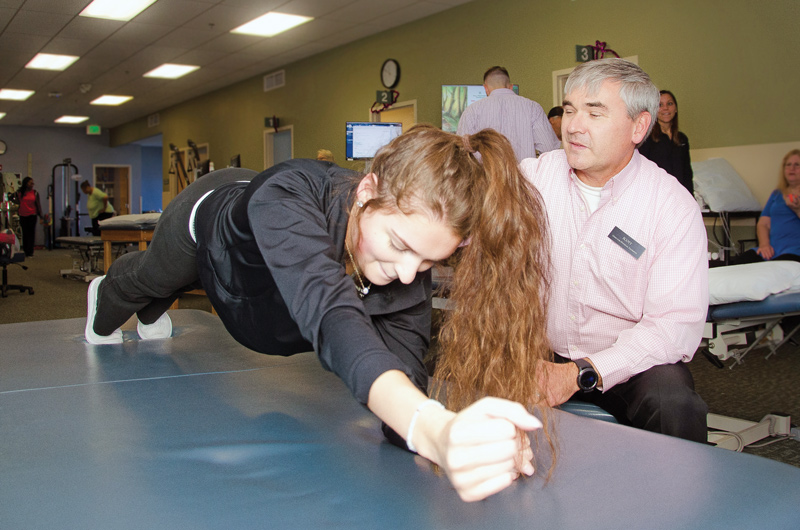
Scott Hyldahl, Physical Therapist: Everybody always thinks football is the most common, but around here, I see more soccer injuries. We also see a lot of overuse injuries in the upper extremities in youth baseball, volleyball and swimming. Many people don’t think of swimming as an injury-prone sport, but swimmers are bringing their arms above their heads repeatedly, and often practice five or more times a week.
Q: What factors contribute to sports injuries in children?
Accousti: The fact that they are growing creates some specific challenges. When boys hit 13 or 14, their bones actually get weaker. This is because they are growing very fast. At the same time, their muscles are getting stronger. This combination makes them more prone to injury. For boys, this period is from about age 12 or 13 until 16. For girls it is about 12 to 14 or 15.
Overuse is another factor. If you look at youth baseball players, as the kids start learning more advanced pitching techniques and they start adding some spin on the ball, that puts a lot of stress on their shoulders.
Richards: Overuse is a big cause of upper extremity (arm and shoulder) injuries. Teams are getting better at pitch-count tracking, but when kids play for multiple leagues and travel teams, it is hard to track it across multiple leagues, so parents can play a big role in prevention by being vigilant.
One way to avoid overuse injuries is to try to avoid repetitive movements across all the sports a child does. If you don’t want to have an overuse injury in an arm or shoulder, you shouldn’t play baseball all summer and then be quarterback in the fall.
Q: We tend to think of kids as being made of rubber, able to bounce back from things. But can childhood sports injuries cause long-term effects?
Accousti: In general, kids do heal much faster, whether it’s a fracture or an overuse injury. Usually all that’s needed is some rest, some anti-inflammatories, maybe some physical therapy. Probably 95 percent of child injuries I see respond to rest, anti-inflammatories or therapy. Very rarely do you need surgery.
One thing that does stay with you is if you are in a contact sport, such as wrestling, football, sometimes basketball, and you have a traumatic shoulder dislocation. Those tend to recur. If you dislocate your shoulder when you are 17, there is a very high likelihood you will continue to dislocate into your 20s, whereas if you dislocate your shoulder for the first time in your 50s, the chance of it coming out again is actually very low.
Q: Are there proactive steps parents can help their children take to prevent injury?
Richards: Proper warmup is very important. A routine that I like is called “Ready, Set, Prevent.” It’s a 20-minute warmup that is neuro-muscular training. You do it before practice or a game, and it gets you ready to compete. Studies have shown that patients who use this warmup versus those who don’t have a two-fold decrease in injuries to the lower extremities. You can find videos with the entire routine by searching “Ready, Set, Prevent” on YouTube.
Hyldahl: Cross-training or taking a break between seasons is also a good idea. Sometimes rest can be the best thing.
Q: How can parents know when their child’s injury or discomfort has reached a point where it’s time to see a doctor?
Accousti: If they look like they are grimacing while they are performing their sport, then they should probably be checked out. But the real warning sign is if something hurts when they are not playing or practicing. It’s not normal for a child to be sitting in English class saying their shoulder or knee or back hurts. There is a difference between muscle burn or soreness during an activity versus joint pain, which is more of a sharp, intense kind of discomfort.
Hyldahl: Listen to your children. A lot of times they will tell you it hurts. We are used to saying, “You’re fine!” when they are younger. That is not always the case. The idea of “no pain, no gain” is not always accurate or true. I think people are more aware of that now than 10 or 20 years ago. But I do think you see more kids that are doing year-round training and travel sports starting at much earlier ages right now. You should also look for those nonverbal clues. Does it look like they are hurting? Are they grabbing their shoulder or favoring one leg?
Q: What makes Mary Washington Orthopedics in affiliation with FOA a good option for families seeking treatment for these kinds of injuries?
Accousti: Among all of our experienced specialists, we have the entire body covered, from feet to knees to spinal, shoulder and hand issues. We’ve also recently brought on Dr. Richards with pediatric sports experience. I think it’s also helpful to families in our region that our doctors rotate among our Fredericksburg, Massaponax and North Stafford offices. And our physical therapy is really amazing, and available at all three locations. They are just so highly trained and specialized; they really do a great job. Part of the reason we have such great outcomes is because of our therapy.
Hyldahl: Having the physical therapists co-located with the doctors creates a great continuity of care. We are able to talk to the physicians and give them updates on patients. If I have a question, I can access all their information on the computer database. It translates to a better outcome for the patient.
To learn more about Mary Washington Orthopedics in affiliation with FOA, visit practices.mwhc.com.