

This would seem like a simple question, and in one sense, it
is.
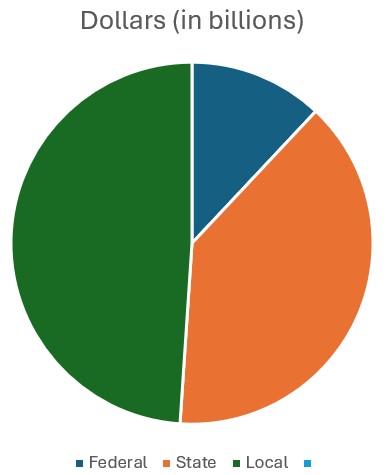
School systems in Virginia receive funding from three
sources: Federal government, State government, and Local government.
Here’s a breakdown of how much each of these contribute,
according to educationdata.org.
How the amounts that state and local governments must provide
are determined, however, is far from simple.
State Funding
Virginia is just one of a handful of states that figures the
state allocation based not on the number of students, but the amount of
staffing a school is expected to require. This is referred to generally as the
SOQ (Standards of Quality). Note: There are actually seven standards of
quality – only one is used to determine funding levels.
The funding formula is complex and has in recent years come
under fire from across the political aisle, leading to serious
talk of funding reform. For an in-depth look at the formula, you can access
this dated PowerPoint
presentation on the Virginia Department of Education website.
There are three basic parts:
1.
Determine the total number of staff positions
per school division
2.
Determine the cost to fund that staffing level
3.
Divide that total between the state and local
governments based on localities’ ability to pay.
(This summary is based upon a Washington Post piece, “Virginia
underfunds K-12 education with flawed formula, report finds”)
The SOQ funding formula, however, works in concert with what
is known as the Local Composite Index, or LCI, which is determined every two
years. It sets the amount of a district’s schools budget the locality should
pay.
Locality Funding
Local funding is also set by the state and is known as the
Local Composite Index, or LCI.
Like SOQ, the LCI is a complex formula that is not easily
understood. However, it is based on the following factors, according to the Virginia
Department of Education:
- True
value of real property (weighted 50 percent) - Adjusted
gross income (weighted 40 percent) - Taxable
retail sales (weighted 10 percent) - Each
locality’s index is adjusted to maintain an overall statewide local share
of 45 percent and an overall state share of 55 percent.
This funding has drawn considerable attention. The LCI works
in tandem with the SOQ to ensure that statewide, local funding accounts
for 45% or education dollars and state funding 55%
The Virginia
Municipal League has regularly noted that there are two major challenges
for localities with the LCI:
·
LCI does not measure students’ educational
needs. Instead, it effectively suppresses the state’s funding obligation.
·
A single change to the formula to one school
division’s LCI affects, either positively or negatively, all school divisions.
Shortchanging Virginia Schools
For the reasons listed above, and more, Virginia has
historically lagged neighboring states in adequately funding public schools.
That was the conclusion reached by a study conducted in 2024 by the Joint
Legislative & Audit Review Commission, which said:
“Virginia school divisions receive less K–12 funding per
student than the 50-state average, the regional average, and three of
Virginia’s five bordering states (figure). School divisions in other states
receive 14 percent more per student than school divisions in Virginia, on
average, after normalizing for differences in cost of labor among states. This
equates to about $1,900 more per student than Virginia.”
Where does your school stand?
This complex system means that funding per pupil varies
widely not only from district to district, but from school-to-school in the
same district.
To see where your school or district falls in funds received
from state and local governments, you can easily discover this information by
going to the Edunomics Lab, which
is housed at Georgetown University.
Martin Davis is Editor-in-Chief of the FXBG Advance, our
sister nonprofit newsroom. For more of its outstanding coverage of education
issues go to fxbgadvance.com.