


When most people think of surgeons, they picture the operating room: bright overhead lights, silver, sterilized instruments laid out on shiny trays and the surgeon and their team dressed from head to toe in surgical gowns, scrub caps and masks. Yet, the truth is that a patient’s journey with a surgeon begins long before they ever see the operating room.
To shed light on what general surgeons really do, as well as recent advancements in surgical technologies, we spoke with Dr. Eric Thomas and Dr. Luan Tran, general surgeons at Premier Surgical, affiliated with Spotsylvania Regional Medical Center, part of HCA Healthcare.
General Surgery Encompasses More Than People Realize
From gallbladder disease, cysts, acid reflux, hemorrhoids and hernias to colon and breast cancers, the conditions treated by general surgeons are numerous. Dr. Tran, who specializes in diseases of the gallbladder, appendix and hernias, explained that general surgery does involve some form of cutting or incision, but that includes in-office procedures as well. “Small, minor conditions can be treated under local anesthetic in our office,” he said.
In addition to the wide variety of conditions general surgeons treat, depending on the diagnosis, a general surgeon may meet with the patient multiple times before the procedure is even scheduled, and almost everyone will see the surgeon at least once post-operation.

Dr. Luan Tran
Dr. Tran said, “For example, we’ll see high-risk breast cancer patients in consultation, we’ll talk about their diagnosis and we’ll talk about surgical treatment options. After their surgery, they have their treatments from the other doctors involved in their care, but we still tend to follow up with mammograms and see them every year to make sure that they’re okay.”
While many patients may be tempted to wait to be seen for various diseases until symptoms become severe, Dr. Tran emphasized the importance of seeking help when symptoms first begin.
Hernias, for example, typically become more difficult to repair the longer the patient waits. “We always recommend surgery if a hernia causes any type of symptom, even mild discomfort,” Dr. Tran explained. “It’s easier to fix a hernia when it’s smaller, as opposed to when it grows over time.”
Gallbladder disease is another condition with symptoms that patients frequently dismiss. While many people have gallstones without ever developing symptoms, pain in the upper abdomen, particularly after eating fatty, greasy or spicy foods, may signal that treatment is needed. Sometimes, the pain only occurs after a person lies down at night to sleep.
When you have abdominal pain, or pain of any kind, for that matter, it’s always better to get checked.
Dr. Tran remarked, “If something hurts or causes discomfort, or it limits a person in any way from living their life to the fullest, that’s a reason to go seek evaluation, if not by a surgeon, by a healthcare provider at the very minimum.”
Seeing a Surgeon Doesn’t Necessarily Mean Surgery
One of the biggest misconceptions patients often have is that being referred to a surgeon automatically means they’ll be having an operation.
In reality, Dr. Tran said that the first appointment is really just a conversation.
“I always encourage patients to have the initial evaluation, even if they’re undecided,” he said. “It never hurts to get the information to make a decision that’s right for them. Just because you come see us about a potentially surgical curable or fixable condition doesn’t obligate you to have the surgery.”
Rather than telling patients what they have to do, Dr. Tran focuses on helping them understand their condition by using diagrams to explain what’s happening inside their body, what treatment options are available and what recovery might look like.
For many common conditions, treatment may not even involve surgery. For example, acid reflux can often be managed with lifestyle and dietary changes or medications.
“I try to be as informative as I can so that the
patient can understand what their options are.
You don’t have to do anything you don’t want to.”
– Dr. Luan Tran
How Robotic Surgery Is Changing Patient Care
In cases where surgery is the right choice, advances in medical technology are making procedures less invasive, more precise and conducive to a faster recovery.
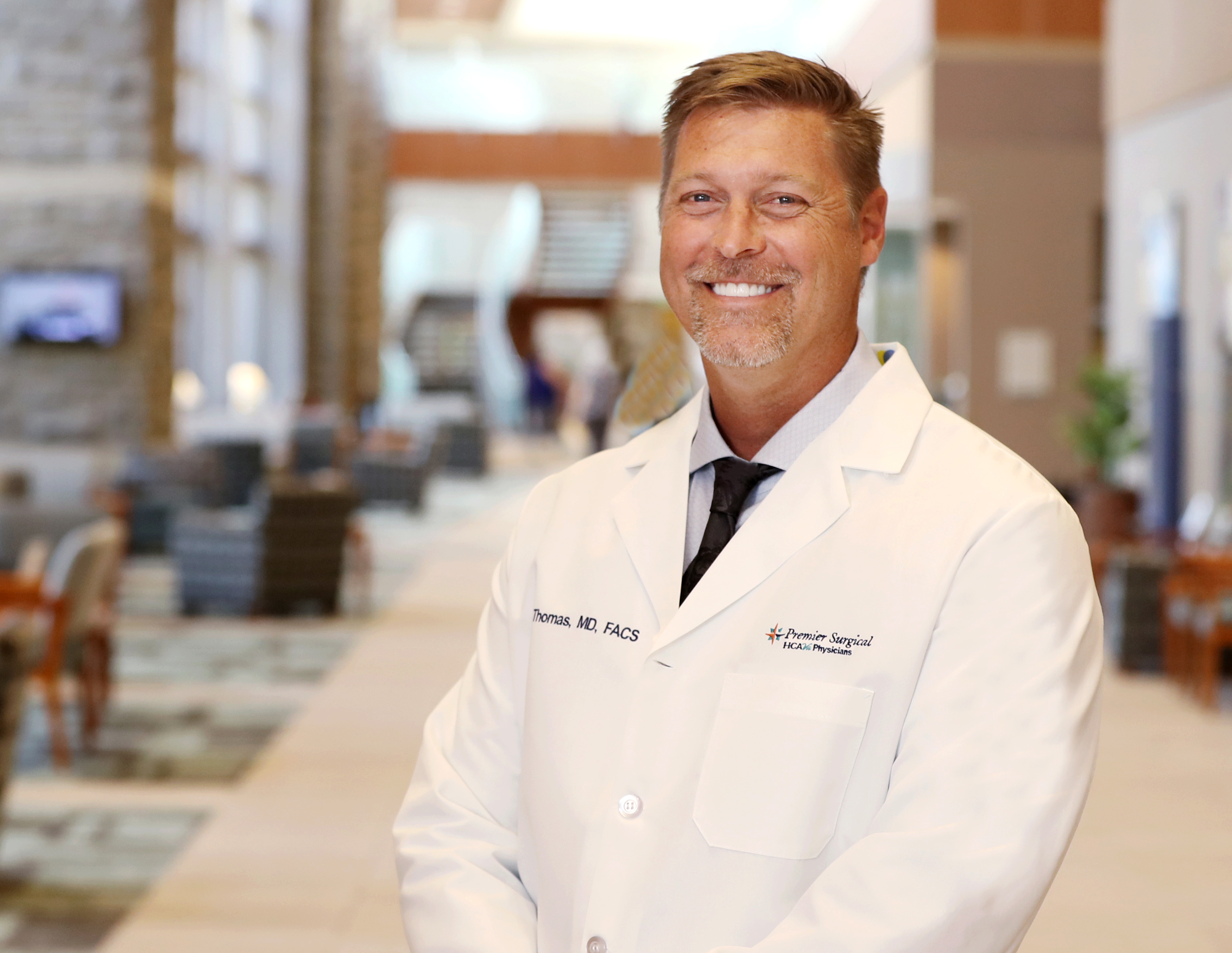
Dr. Eric Thomas
Dr. Thomas, who recently performed his 2,000th robotic-assisted surgery and who trains fellow surgeons in the use of cutting-edge robotic surgical techniques, said that one of the biggest misconceptions patients have is that surgeries are done using autonomous robots, meaning that the surgeon is just standing by.
While there are some orthopedic surgeries that can be done by semi-autonomous robots (i.e., the surgeon performs part of the procedure and the robot takes over the other part after it’s
programmed to do so), in general, it’s the non-autonomous robots that are involved in robotic-assisted surgery. This means that every robotic movement is controlled by the surgeon using a surgeon’s console that has a three-dimensional viewer that allows for extreme precision.
“Robotics has given us instruments with more flexibility than the human wrist, so you’re able to do finer dissections,” said Dr. Thomas. “You can do things minimally invasive that you can’t do laparoscopic. Minimally-invasive robotic surgery is less painful and gets patients back to their normal activities faster.”
Robotic-assisted surgery can be used for many general surgery procedures, including gallbladder removal, gastric bypasses, hernia surgery, anti-reflux procedures, liver surgeries, splenectomies, colectomies and small bowel resections.
For patients, these robotic-assisted surgeries usually mean shorter hospital stays, lower hospital readmission rates and less chance of wound infections or other complications.
Dr. Thomas noted just how quickly patients can recover after robotic surgery. He said, “I’ve had people back on the golf course in a week. I’ve had people run five miles before they come back and see me at their two-week post-op visit.”
Knowledge Is Life-Saving Power
Whether you’re living with abdominal pain, persistent reflux or another symptom, it’s important to seek answers.
Equally important is keeping up with preventive care, including routine mammograms after age 40 and colonoscopies after age 45. Talk with your doctor about when to begin breast cancer and colorectal cancer screenings, especially if you have a personal or family history that may affect your risk. Dr. Tran noted that these types of preventative procedures are often much easier than people anticipate, and they can save your life in the long run.
If you are looking at the possibility of a surgical procedure, Dr. Thomas advised people to seek as much information as they can. “Do your research on your procedure, on your condition and on the surgeon. Ask every question you want to ask, and if you forget, call back and ask. The only bad question is the one you forget to ask.”
At the end of the day, both Dr. Thomas and Dr. Tran want people to know that the goal isn’t to pressure anyone into treatment but to provide knowledge, options and guidance to empower people to make informed decisions about their care.
If something does not feel right, do not wait for it to become an emergency. To discuss abdominal pain, a possible hernia, persistent reflux or another concern, schedule an appointment with Premier Surgical at 540-993-4294 or PremierSurg.com.