
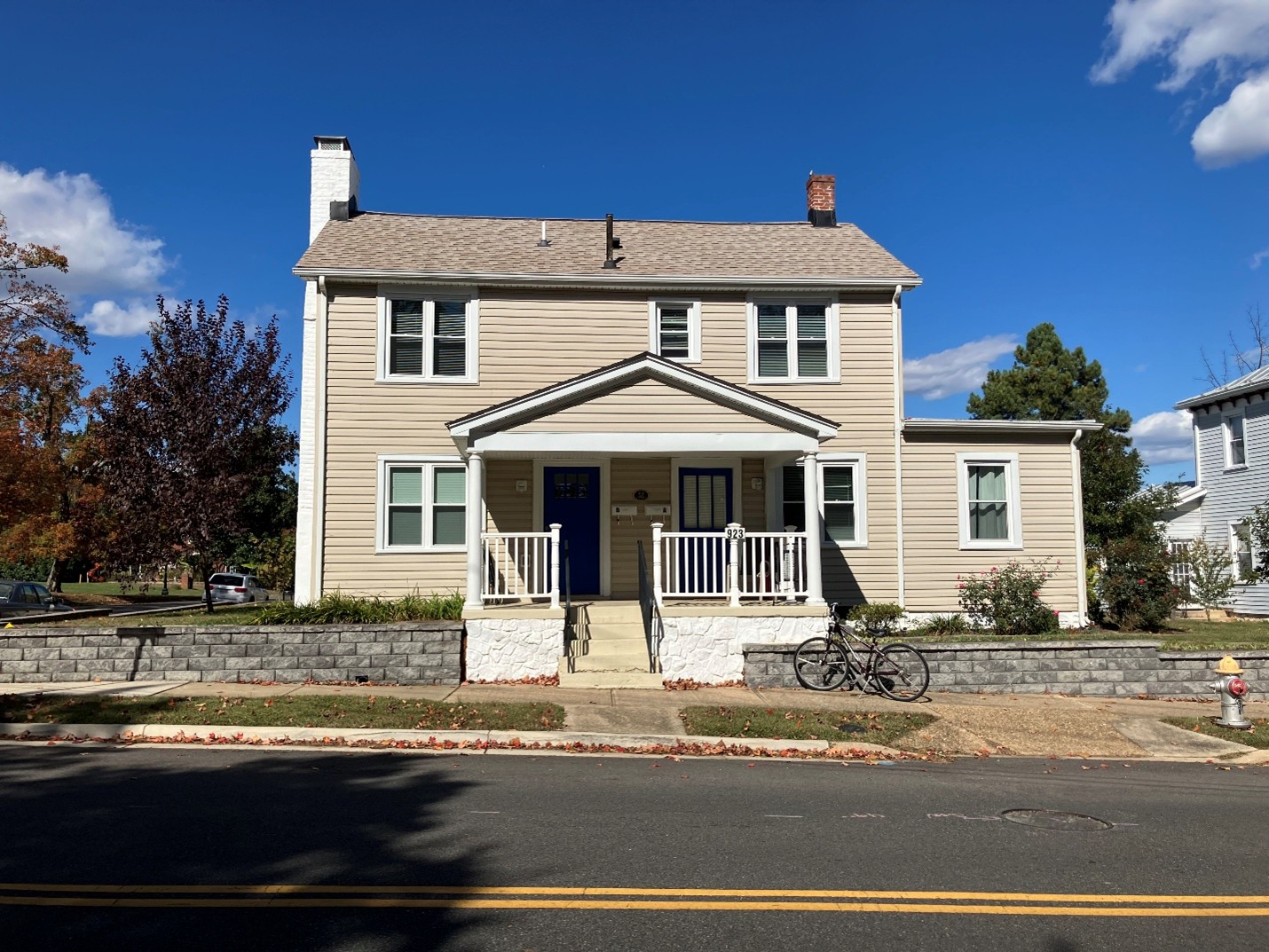
Among the many owners of this property are members of the
family for whom Austin, Texas, is named; a Black barber who purchased and
emancipated family members and later became chief butler at the White House
under President John Tyler; and immigrants from Italy and Jamaica who went on
to become local leaders.
Confederate troops were situated on the property during
the Battle of Fredericksburg in 1862, and the entire area was bombarded by
Union artillery, but the circa-1822 house remained intact. Its Civil War-era
inhabitants, the Wrenn family, are the subject of a 2004 book of historical
fiction, Beside the Stone Wall, written by a descendant.
The original builder, Charles Austin, moved to
Fredericksburg in 1809 after the lead mill he and his father owned in Wythe
County went bankrupt. His cousin, Stephen Fuller Austin, was responsible for
colonizing the then-territory of Texas, and the state capital, Austin, is named
for him.
Charles Austin was a shipping agent who sold all kinds of
merchandise—from millstones to flour to pianos to hogs—according to research
prepared by Wayne and Donna Stanton for the Historic Fredericksburg
Foundation’s marker program. The lot that is now 923 Hanover Street was one of
his many holdings, and in 1823, land tax records note that a house had been
built there.
By 1824, there were apparently four frame buildings on
the property—a workshop, a blacksmith, a kitchen and a stable. James Wilkins, a
barber who worked out of a shop on Caroline Street and is described in local
newspapers as “a professor of shaving, adept at hair coloring, and a
connoisseur of perfuming,” bought the property in 1826.
Wilkins owned other properties nearby, including 919
Hanover Street. He had been born into slavery, but four years after his
emancipation, he had made enough money as a barber to purchase and free his two
daughters, Sarah Ann and Frances; his son, Charles; and his wife or sister,
Becky.
According to Wilkins’ 1858 obituary in the Virginia
Herald, John Tyler visited his shop in Fredericksburg while he was vice
president. When Tyler became president in 1841, he remembered Wilkins’ skill
and installed him as chief butler in the White House. Wilkins’ daughter was
also employed there at a salary of $300 per year.
Wilkins later moved to Philadelphia, according to his
obituary, where “though quite wealthy, he presided over the destinies of a
barber shop, which seemed to have a charm for him.”
By 1847, 923 Hanover Street was owned by Lewis Wrenn, who
had a license to operate an “ordinary”—a business offering food, drink and
accommodations. He also worked as a tinner and a cooper.
During the Civil War, four of Wrenn’s sons enlisted in
the Confederate Army, and Wrenn himself was detained along with 13 other
Fredericksburg residents at Old Capitol Prison. They were held as hostages in
exchange for the release of Union officers imprisoned in Richmond. He was
released before the bombardment of Fredericksburg in 1862 but was taken
prisoner again in 1864.
In the late 1890s, 923 Hanover was owned by the McDonnell
brothers and housed a concrete business that won a contract to pave National
Boulevard—now Lafayette Boulevard—between Princess Anne Street and the National
Cemetery.
In 1938, Giovanni Rosario “Solly” Ventura bought 923
Hanover at auction. Ventura was born in Caccamo, Italy, and immigrated to the
U.S. with his family in 1906, when he was 14 years old. He and his wife and
another couple ran the Fredericksburg Fruit Market. In 1922, he opened Jacob’s
Old Stand, a shoeshine parlor, and in 1938, he opened Fredericksburg
Distributing Co., a wholesale fruit, beer and wine company.
The Venturas used 923 Hanover as a rental property and
invested $1,500 in the house in 1949. It stayed in the Ventura family until
1971, when Daphne and Norman Brooks—immigrants from Jamaica—bought it together
with their daughter, Moonyean, and her husband, Raymond Jones.
Jones was a physician in the Army and in 1967 opened a
pediatrics practice in Fredericksburg. According to a 1985 Free Lance–Star
article, Jones was among a group of physicians in private practice to open and
staff a Children’s Center at Mary Washington Hospital. It was open from 6 to 9
p.m. to serve the needs of parents who were unable to bring their children in
during regular office hours.
Today, 923 Hanover Street is owned by the Stantons, who
carried out extensive repairs to the property between 2018 and 2021. According
to Stanton, the renovations resulted in several interesting discoveries, such
as a second roof made of tin under the current one and “bricks, beams, stones
and blacksmithing debris that span centuries of time.”
This article is published under Creative Commons
license CC BY-NC-ND. It was created by Fredericksburg Parent’s sister
publication, the FXBG Advance, a nonprofit newsroom serving the community.
Visit fxbgadvance.com for more information. Bolder Journalism, Supporting
Communities, Independent Reporting