
Turbidity was the word of the day for 6th grade students at
Walker-Grant Middle School.
It’s a measure of the relative clarity of a liquid, and this
week, the students were determining the turbidity levels of the Rappahannock
River.
Dirt and soil are the number one pollutants of our local
river, Jennifer Gron, field trip manager for Friends of the Rappahannock,
reminded the students.
“It washes into the river after a rainstorm like we just
had,” Gron said. “We want low turbidity.”
To measure turbidity levels, the students collected a bucket
of river water and poured it into a tall, clear plastic tube. They took turns
peering down the tube, attempting to see the black-and-white disc positioned at
the very bottom.
“If you can’t get a good view of the disk, that means if the
water is as deep as this tube, sunlight is not getting to the bottom,” Gron
said. “It is getting blocked by sediment in the water, and any plants that are
trying to grow at the bottom are not getting sunlight.”
On Tuesday, the disk was partly visible, meaning the
turbidity is “not bad,” she said.
All 6th graders at Walker-Grant Middle School in
Fredericksburg visited Friends of the Rappahannock this week for an outdoor
field experience designed to get them “up and close” to the river.
“The goal is for them to learn more about the river and
increase their environmental literacy,” Gron explained. “They’ll learn how
their daily activities impact the river and hopefully, that will inspire them
to mitigate those activities.”
In 2022, FOR received a $236,000, three-year grant from the
National Oceanic and Atmospheric Administration to fund watershed education
experiences for 4th, 6th, and 9th graders in Fredericksburg City Public
Schools.
Funded by the grant, FOR last year began bringing Meaningful
Watershed Education Experiences to city students. These immersive
investigations into local environmental issues, of which this week’s field
trips are an example, are required by states that participate in the 2014
Chesapeake Bay Watershed Agreement.
Last year’s programming was for 9th graders. This year,
programming expanded to include 6th graders, and 4th graders will be included
next year, Gron said.
On Tuesday, in addition to testing turbidity levels, the
students tested the pH and oxygen levels, as well as the temperature of the
water.
“Why do we care about the temperature?” Gron asked. “When
the temperature increases, it holds less oxygen, and that creates dead zones.”
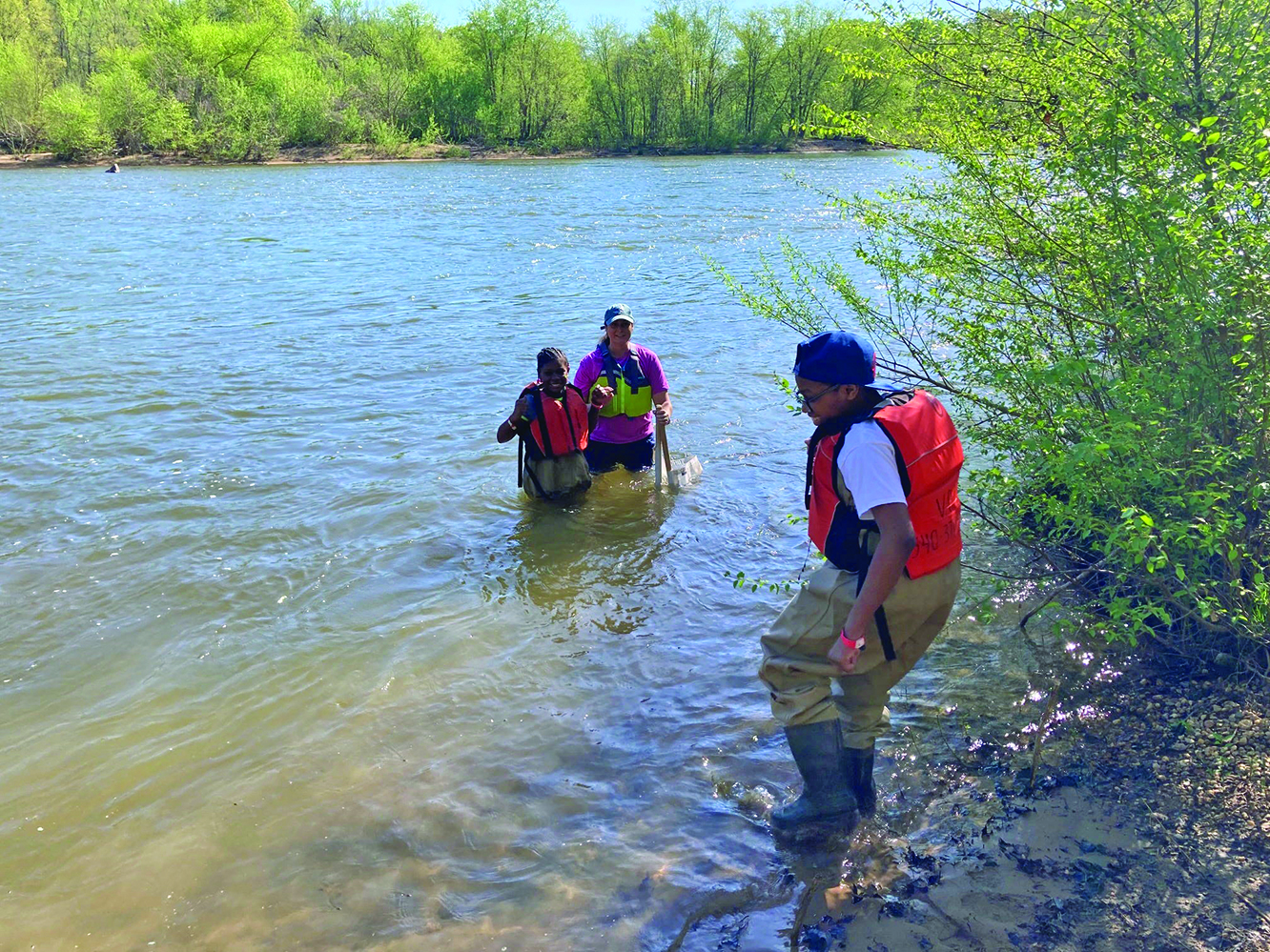
They also donned waders and ventured deeper into the river
to collect soil from the bottom, which they combed through with tweezers and a
magnifying glass, looking for small invertebrates such as mayflies, snails and
crayfish.
These creatures are examples of benthic macroinvertebrates.
They are sensitive to pollution and as such are important water quality
indicators.
On Tuesday, students found spiders, scuds, crayfish, and
aquatic worms. They also measured a pH level of 7—in the normal range—and a
temperature of about 65 degrees.
Their conclusion? Our river is in pretty good health—at
least for today.


