

Preparing to bring a new baby home means making lots of
decisions—Which car seat to get? What color to paint the nursery? How many will
it take to put the crib together?
One of the most important choices you can make to ensure
your baby’s health and safety during the first year of life is to learn the
principles of safe infant sleep, and to make sure anyone who will be caring for
or spending time with your baby also understands them.
Research-backed recommendations for safe infant sleep are a
factor within your control to help prevent accidental death or injury in
infants. Every year in the United
States, there are approximately 3,500 infant sleep-related deaths due to
accidental suffocation, strangulation, or undetermined causes during sleep.
Safe sleeping habits play a role in reducing the risk of sudden infant death
syndrome (SIDS), a leading cause of infant mortality in the U.S., according to
the Centers for Disease Control and Prevention.
Mary Washington Healthcare Promotes Safe Sleep from Day
One
Mary Washington Healthcare is committed to promoting safe
sleep habits at both Mary Washington and Stafford Hospitals. The healthcare
system also educates parents on safe sleep practices for the home, so that parents
and caregivers have the knowledge to help infants avoid sleep-related injuries.
Mary Washington Hospital has earned certification as a Safe
Sleep Leader from Cribs for Kids, a nonprofit dedicated to preventing infant
sleep-related deaths.
“Safe sleep education at Mary Washington Healthcare
starts when mom is admitted to the hospital,” said RiDonna Walker, MSN, RNC-MNN,
Assistant Nurse Manager for Mother Baby and Pediatrics at Mary Washington
Hospital. “Parents can learn about creating a safe environment for their
newborn in our new-parent classes before they deliver, but even if they don’t
take the classes, we are delivering this information when they are under our
care. As soon as baby is delivered, we talk to parents about sleep, because the
babies are in a crib in the room, and in that crib, we just have a fitted
sheet—nothing else.”
Safe sleep habits are reinforced throughout mother and
baby’s stay in the hospital through hourly check-ins, said Terri Lamprinakos,
BSN, RN, NE-BC, Nurse Manager for Labor, Delivery, Recovery, Postpartum &
NICU at Stafford Hospital.
“Every time we walk in that room, we are checking for
safety for mom and baby,” she said. “If there’s a new stuffed animal from a
visitor in the crib, we are taking it out and reminding parents to take it out.
It’s a constant education until you go home. It might even seem annoying, but
it is just so important that we feel very strongly about sending parents home
with these safe sleep habits.”
Set Up for Safe Sleep at Home
Sleep deprivation is one of the hardest parts of
bringing home a newborn. So a big part of setting up a safe sleep environment
at home is anticipating those times when you may be prone to fall asleep while
feeding an infant.
Lamprinakos remembers how hard it was as a new mother
to not fall asleep while breastfeeding. In the hospital, she sees this tendency
frequently with new mothers. But it’s important not to give into the temptation
to fall asleep while feeding an infant, even “just this once.” If you feel you
are going to fall asleep, she said, get up and put the baby down in the crib,
or have your partner or another caregiver take the baby so that you can rest.
“It’s important to have somebody helping you at home,
so that if you do get tired, they recognize that, and can help you,”
Lamprinakos said.
“It takes a village,” Walker said of infant care, and
that’s why Mary Washington Healthcare emphasizes to parents that anybody who is
going to be helping to care for their baby—grandparents, babysitters, friends
or anybody else—needs to have the same information about safe infant sleep that
Mary Washington Healthcare sends parents home with.
“It really has to be a commitment by every caregiver,”
Walker said.
To learn more about Mary Washington Healthcare’s
commitment to safe infant sleep, visit safesleep.mwhc.com.
Do’s and Don’ts of Safe Infant Sleep
These guidelines apply to all sleep situations, including
nighttime sleep and naps during the day.
DO:
–
Place babies down to sleep on their backs.
–
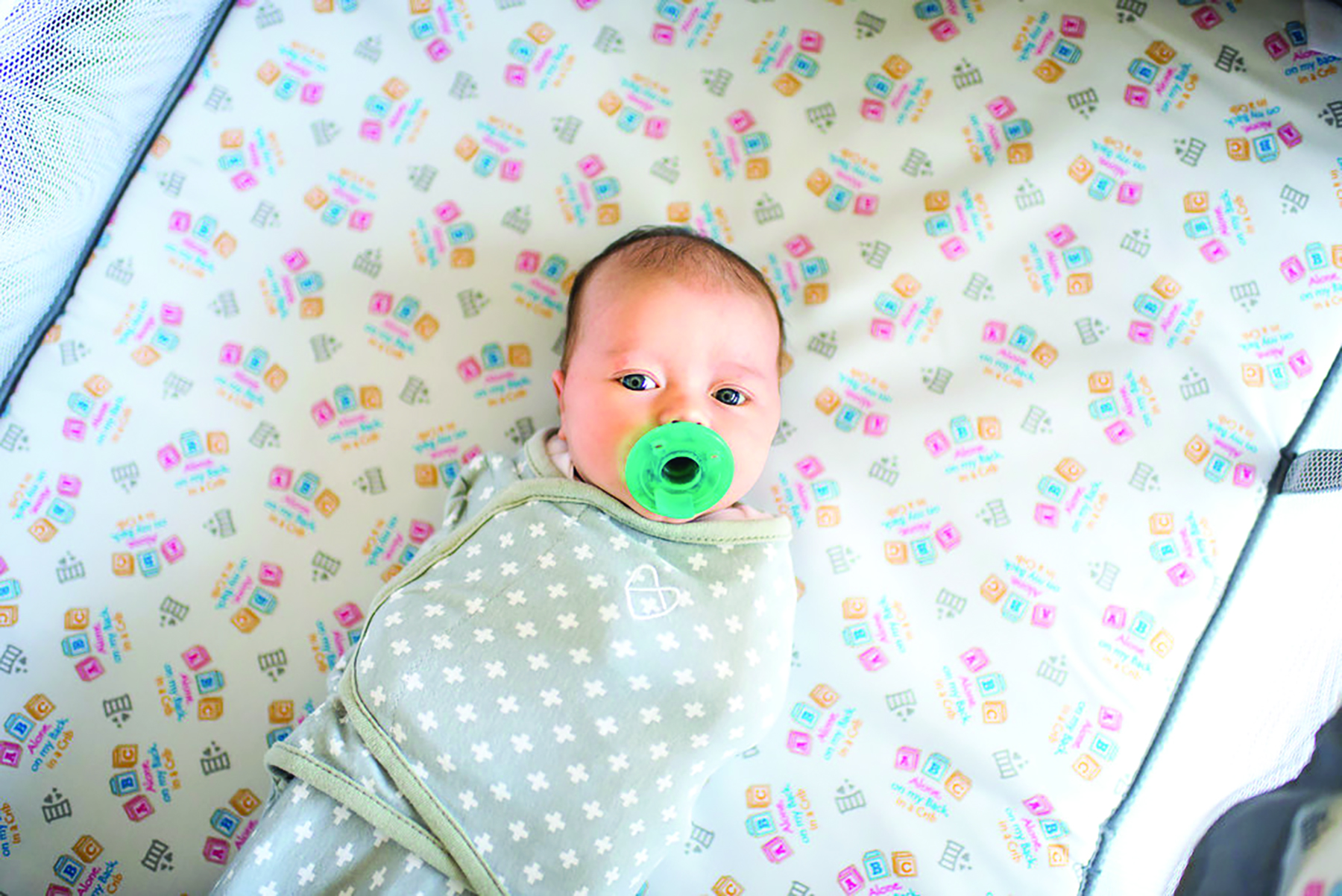
Place babies on a firm crib mattress, covered
only by a tight fitted sheet.
–
Breastfeed your baby, and offer a pacifier after
breastfeeding is well established.
–
Use a breathable, fitted blanket to swaddle your
baby, such as the Halo SleepSack, which is distributed to all new parents who
give birth at Mary Washington Hospital or Stafford Hospital.
–
Create a safe sleeping space by setting up a
crib or bassinet in the room where you sleep, to make nighttime care easy
without having baby in your bed.
–
Make sure everyone who cares for your baby knows how to
reduce the risk of sleep-related death or sudden infant death syndrome (SIDS)
by following these important guidelines
DON’T:
–
Bring an infant into your bed to sleep.
–
Place stuffed animals, crib bumpers or other fluffy
décor in a crib or bassinet where your baby will sleep. These items pose a
suffocation risk.
–
Use sleep positioners, wedges or pillows in the
crib or bassinet to prop up your infant.
–
Allow babies to sleep wearing hats, as they can
pull them down over their faces, making breathing more difficult.
–
Allow babies to sleep in swings, car seats and
other carriers or play equipment. Babies should only sleep on a firm, flat
mattress.
–
Allow babies to sleep with pacifiers that have
soft stuffed animals attached should not be with a baby during sleep.
–
Smoke around your baby, or inside a room where
he or she will be sleeping.
To learn more about safe infant sleep, visit
safesleepacademy.org.
—