

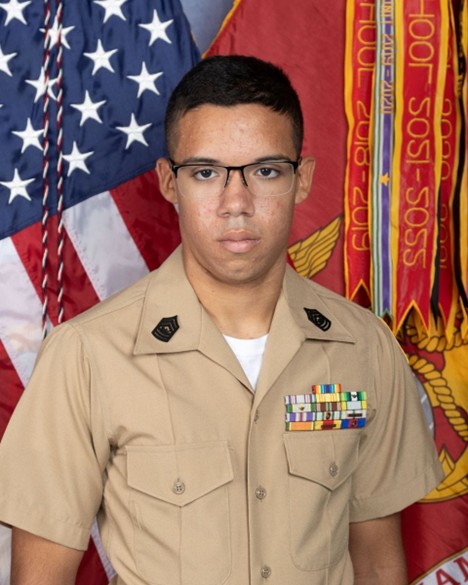
Cadet Abdiel
Betancourt of Mountain View High School wins top JROTC honor for leadership and
support of others in Fredericksburg’s youth community.
High school sits at the nexus of childhood and adulthood,
along with all the challenges and worries that brings. Finding established
pathways through those years is recognized as key to ensuring that students
make a smooth transition to the next stage of life.
For Abdiel Betancourt, that pathway wove through the Marine
Corps Junior Reserve Officer Training Corps (JROTC) program at Mountain View
High School. He joined the program his freshman year, working his way to
becoming an officer.
“I joined because I wasn’t sure what to do in my future,”
Cadet First Lieutenant Abdiel Betancourt told . As it turns out, military
service isn’t in the cards for Cadet Betancourt. Rather, he is hoping to attend
Texas A&M University and study accounting and business.
He credits his experiences at JROTC, however, for helping
him excel at Mountain View and positioning him to successfully make the
transition to college. He encourages other students looking for something to
help them through high school to give JROTC a try.
Cadet Betancourt carries a heavy load at Mountain View. In
addition to being a member of the Commonwealth Governor’s School (CGS) and
taking Advanced Placement courses, he was a runner and handled the load that
comes with JROTC.
The key to balancing all that was discipline and a
commitment to seeing things through to their completion—traits he learned in
JROTC.
“Discipline will help as you pursue academics,” Cadet
Betancourt said, but “there’s also the loyalty aspect and commitment to
sticking to the program.”
Such skills are invaluable to students whether or not they
choose a military career after high school.
For More Than People Seeking a Military Career
“Anyone can join,” said Lt. Col. Raymond Mirenda USMC/RET
who runs the program. “If you feel you’re not physically fit, or don’t have the
academics, we will help train you. We are there to support you.”
The program itself, he continues, “is not about recruiting
service members. This is about developing informed responsible citizens.”
It’s particularly helpful, Lt. Col. Mirenda said, for kids
“who are struggling, looking for direction and guidance.” The program teaches
“respect for and understanding of authority within the school system.”
That training builds individual character traits, but it
also helps students learn to function cooperatively in a larger group — putting
others above one’s self.
“I was the F-1 Chief and Officer,” Cadet Betancourt said.
His responsibilities included keeping all the records for the more than 160
cadets in the program. It’s highly detailed work, and failure to keep the
records properly can have a deleterious effect on the JROTC students.
Successfully keeping those records straight “will really help me in the
future,” Betancourt said.
It’s not just doing the work, however. It’s also learning to
do the work and “to always be enthusiastic and helpful for my other Marines,”
Cadet Betancourt said.
The people he has worked with in the program are part of a
“community and my best friends” he told the Advance. “Comradery and lifting up
one another” is what he enjoyed most about the program. And it is what he will
carry with him going forward.
From Timid to Tops
By his own admission, Cadet Betancourt was not an outgoing
person when he joined JROTC. The thought of doing interviews, or speaking
before groups, was a bit unnerving.
From that timid freshman, however, Cadet Betancourt has
soared to the pinnacle of JROTC training.
This year, he received the Cadet Legion of Valor award. The
award is given to one cadet in each of the regions across the United States.
Cadet Betancourt’s region encompasses Virginia, North Carolina, South Carolina,
Maryland, and Delaware.
Lt. Col. Mirenda puts the significance of the award in
perspective, noting that there are “253 JROTC programs worldwide that work with
some 26,000 cadets – [Cadet Betancourt] is one of 14 selected to receive this
recognition.”
Asked what stands out for him about Cadet Betancourt, Lt.
Col. Mirenda points to his “quiet professionalism.”
Cadet Betancourt is “very humble in how he describes
himself. … He does something to motivate each and every class he is involved
in. He will burn the midnight oil – he would be here hours after others have
left to ensure the administrative side was correct. … This requires selfless
leadership. He would sacrifice his time to make sure that people were looked
at.”